It’s often said that children are the future. But are we giving them a safe, clean and healthy one?
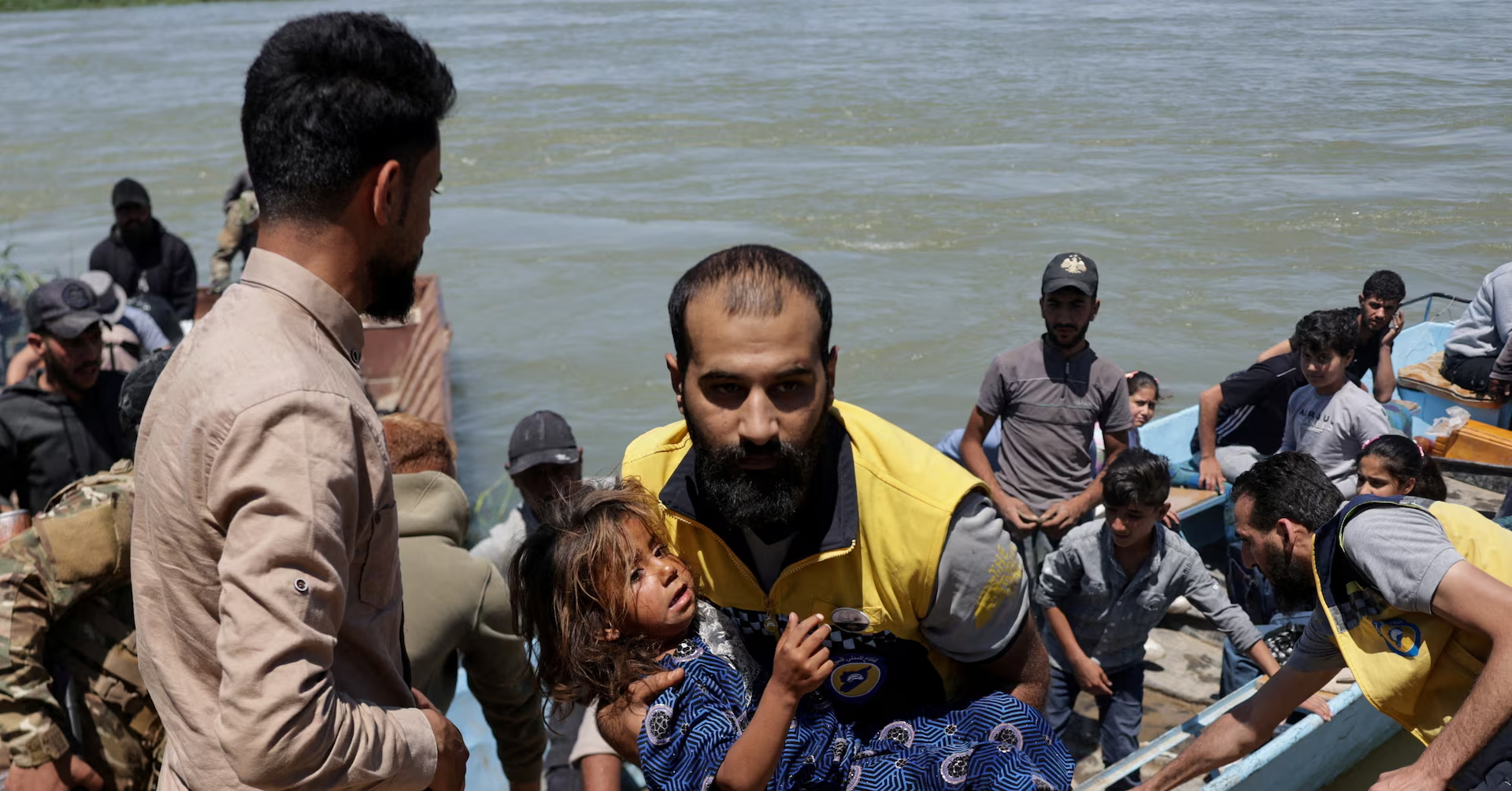
Today’s focus looks at a United Nations report that found that almost all of the world’s children are exposed to at least one climate hazard, with as many as 1.8 billion put in danger by droughts and 1.2 billion by extreme heat.
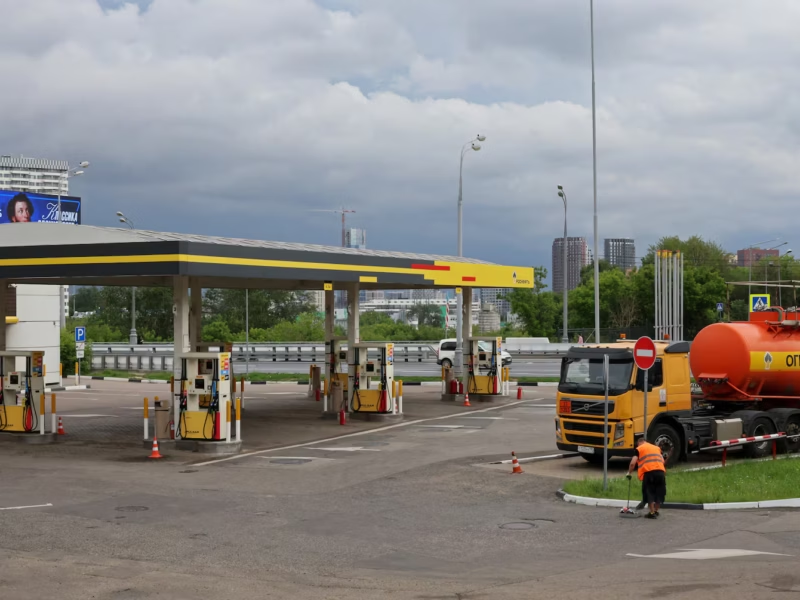
Plus, the Ethical Corp Magazine showed that children are bearing the brunt of fracking health risks in the United States’ push to “drill, baby, drill” as an oil company in Arlington, Texas, received permits to add nine new gas wells at two sites, as close as a third of a mile away from several primary and secondary schools.
Let’s start with the report from the United Nations Children’s Fund (UNICEF) that said children were “disproportionately affected” by a range of intensifying climate-related risks and governments urgently needed to invest in infrastructure, adaptation and disaster management capabilities to reduce their exposure.
“It’s not just the exposure to the single hazards like floods or droughts or heat waves and extreme heat that children face, but it is the exposure to multiple hazards,” said Rohini Sampoornam Swaminathan, UNICEF statistics manager and one of the authors of the report.
As many as 662 million children were at risk from tropical storms, 337 million from riverine floods and 33 million from coastal floods, with 1 billion children also exposed to malaria, mostly in Africa.
In 2024, 242 million children in 85 countries saw their schooling disrupted by climate hazards.Click here for more on the report.
Elsewhere, Terry Slavin, editor-in-chief of Reuters Events Sustainable Business and Ethical Corporation Magazine, spoke to Arlington climate campaigners who found that TotalEnergies E&P Barnett USA (TEEP Barnett) sites had 85 methane pollution events over six months.
She spoke to Ranjana Bhandari, who leads community group Liveable Arlington, which lobbied the City of Arlington to turn down TEEP Barnett’s latest permit near the schools.
While no causal link has been established between fracking and health harms, Bhandari cites a 2022 Yale study that found Pennsylvania children living within 1.2 miles (2 km) of fracking sites at birth were two to three times more likely to develop acute lymphoblastic leukemia.
She also notes that the new 10-well Maverick pad is about 1,000 feet from Mother’s Heart daycare, while another four-well pad already operates roughly 600 feet from the school.
TotalEnergies denies adverse impacts of its operations, and underlines leadership on methane emissions reduction.
This is an incredibly eye-opening story and I urge you to click here, opens new tab and read Terry’s piece.
Climate Buzz
French weather service Meteo-France said it had extended its orange heatwave alert to cover 53 departments, or administrative districts, across France starting on Friday at noon. Temperatures are expected to rise further next week, close to 8 degrees Celsius (46.4 degrees Fahrenheit) above seasonal norms in the low 30s on Monday, likely boosting demand for cooling, said analysts at Engie’s EnergyScan.
French state-owned utility EDF warned that three nuclear plants face production curbs next week because of high temperatures on the Rhone and Garonne rivers as France grapples with its second heatwave this spring.
Meanwhile, Spain is bracing for the first heatwave of the season, with the risk of fire forecast to rise sharply from Sunday, particularly across northern interior zones, the national weather service said. The high-speed rail service between Spain’s Madrid and Barcelona was disrupted on Thursday after a wildfire broke out near a section in Catalonia, rail operator Adif said.
A super El Nino is likely to unsettle global weather and threaten food output in the coming months. The last super El Nino in 2015 to 2016 brought droughts, floods and record global temperatures, disrupting agricultural production from Asia to Africa. But the 2026/27 episode could be different as consecutive years of record harvests have swelled global food inventories, especially in key consuming and exporting countries.
“There is a bit of a silver lining as far as global stocks and recent harvests of rice and other cereals are concerned,” said U.N.’s Food and Agriculture Organisation (FAO) economist Shirley Mustafa. Click here to read more about the silver lining.
Communities in southern Brazil are bracing for an intense El Nino that meteorologists warn could bring extreme rains this year after rebuilding from devastating floods that killed at least 181 people in Porto Alegre, the capital of Rio Grande do Sul state, two years ago. Click here to learn more about the safety measures the city’s Mayor has put in place.
A 115-page report by the Texas Legislature found that Camp Mystic, the Christian summer camp for girls in Texas where 28 people were killed in a 2025 flash flood, did not have written emergency evacuation plans and poorly trained its staff. With the proper plans and counselor training required by state law, there would have been time to evacuate the cabins and for campers to head to high ground safely on foot, the report concluded. Click here to read more about the report.
Sticking with Texas, the Public Utility Commission of Texas has approved the Electric Reliability Council of Texas’ first process for large electricity users, creating a new framework to manage surging grid connection requests from data centers and other high-demand customers.
What to Watch
Bird watchers who flock to Toronto’s Tommy Thompson Park in hopes of spotting migratory birds were left disappointed as the park reported a significant drop in spring and summer bird banding totals compared with historical averages. Click here, opens new tab to watch the full video.
Climate Commentary
Climate Lens
Thank you to all who sent their fun Reuters Climate Monitor observations. Do click here to check out a new feature showing just how hot or cold every World Cup host city is in comparison to the historic average. And do keep your feedback and insights coming! I’ll try and collate all my favourites into a future newsletter focus.
Number of the Week – $11 billion
That’s what it took to get SunZia, the biggest ever clean energy infrastructure project in U.S. history, which took nearly 20 years to permit and build, up and running. The 3,650 megawatt wind farm and 550-mile transmission line will be carrying New Mexico wind power to Arizona and, ultimately, California.

Sharon Kits Kimathi
Read more Europe swelters under heatwave, prompting crisis talks in France
Read more A$K Lauren: Should I open a Trump Account, even if my child isn’t eligible for the free money?